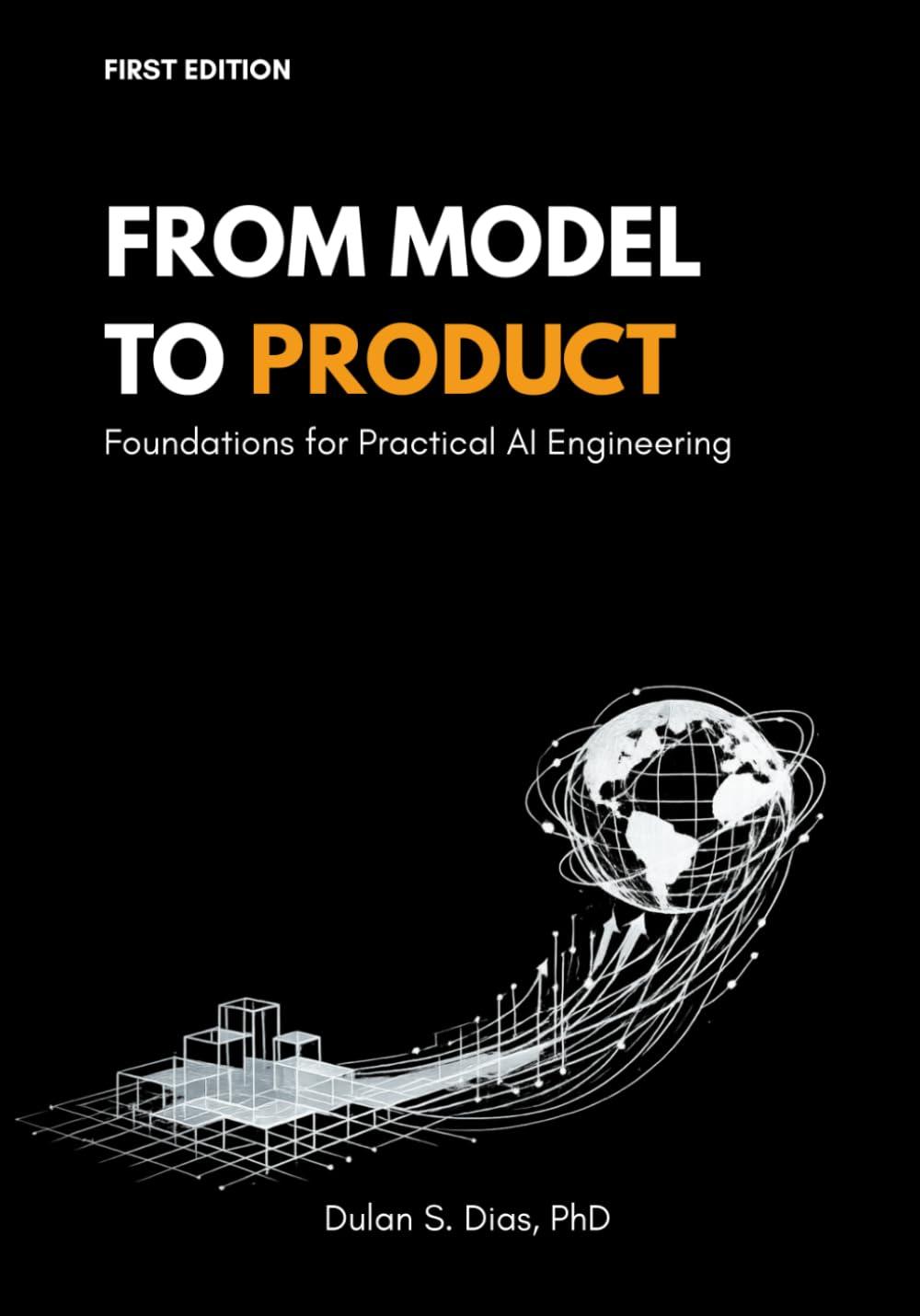
Front cover of From Model to Product: Foundations for Practical AI Engineering, by Dulan S. Dias, PhD
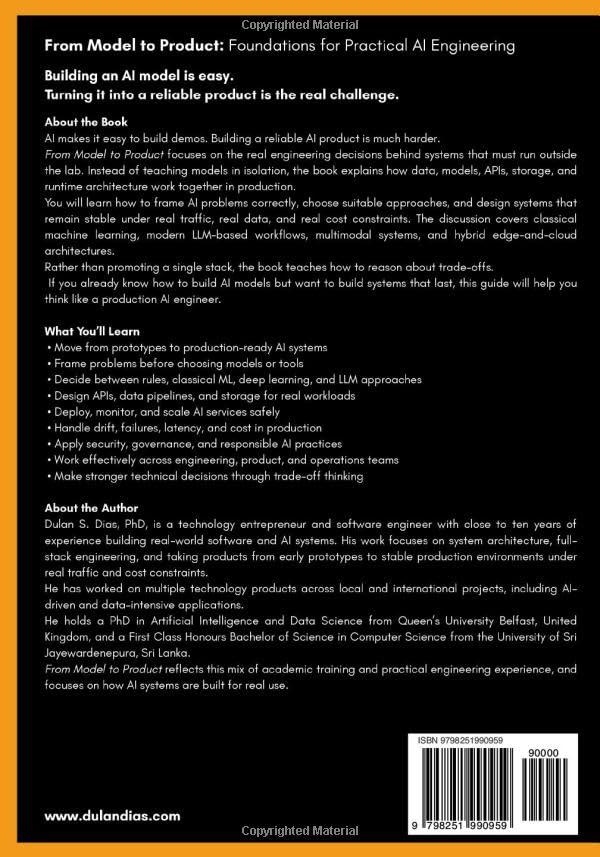
Back cover of From Model to Product
Author
Dr. Dulan Dias
Format
Softcover
Published
March 2026
Pages
403
Size
17.78 × 25.4 × 2.31 cm
Weight
0.9 kg
ISBN
9798251990959
Hardcover ISBN
9798251997958

From Model to Product

Foundations for Practical AI Engineering

By Dr. Dulan Dias · 2026

Artificial intelligence is easy to demonstrate. Building an AI system that actually works in the real world is much harder. This book addresses the core challenge: the hard part is not the model, it's everything around it.

From problem framing and architecture to deployment and production monitoring, this is the practical guide for engineers moving beyond notebooks, and for anyone who built a working prototype with an AI coding assistant and now needs it to hold up with real users.

Buy the softcover

£21.99

Ships to UK addresses. Secure checkout with Stripe; no account needed.

Buy on Amazon(opens in a new tab)

Ships worldwide, at Amazon's price.

Want to track your order? Create an account or sign in before you buy.

What's inside

  • System design principles for production AI
  • Deployment using FastAPI and containerisation
  • Monitoring, cost management, and observability
  • Handling real-world constraints: reliability, concurrency, latency
  • Classical ML, computer vision, and LLM-based approaches
  • Team collaboration and responsible AI governance
  • Edge-and-cloud hybrid architectures
  • Problem framing: knowing when NOT to use AI

Chapters

  1. 1The AI Product Mindsetwhat separates an impressive model from a product people can depend on
  2. 2Problem Framing and Requirementsturning a vague request into a measurable AI problem
  3. 3Choosing the Right Approachrules, search, classical ML, deep learning or an LLM
  4. 4Data Architecture for AIconsistent, trustworthy inputs for training and live use
  5. 5Model Architecture Patternsstructuring the model for real production constraints
  6. 6API-Driven AIputting a model behind a production-ready API
  7. 7System Architecture Patternsthe simplest system that survives load, change and failure
  8. 8Storage and Databases for AI Systemsrelational, NoSQL, vector stores, caches and feature stores
  9. 9Vision on the Edgecomputer vision on a phone, from the data you actually have
  10. 10From Prediction to Product Logicturning a label and a confidence into a safe decision
  11. 11Language Models in Real Systemsgrounded, affordable and available LLM features
  12. 12Building a Complete AI Productone product from separate parts, and redesigning it
  13. 13Packaging & Deploying AI Systemscontainers, versioning, releases and rollback
  14. 14Observability, Monitoring & Model Healthdrift, alerts and cost before users notice
  15. 15Reliability, Scalability & Cost Managementfallbacks, retries, load and spend
  16. 16Working in Teamshow specialists coordinate and keep shipping
  17. 17Ethics, Governance & Riskbias, explainability and governance scaled to risk
  18. 18The Future of AI Engineeringwhat changes, what stays, and the skills that last

Is this the book for you?

Read it if

  • You can get a prototype working, and need it to keep working with real users, uneven traffic and a budget.
  • You are deciding whether a problem needs rules, classical machine learning, deep learning or a language model.
  • You are a software engineer who wants AI judgement, or an ML practitioner who wants architecture and operations skills.
  • You built an app with Cursor, Copilot or another AI coding assistant and now need it to hold up in production.
  • You lead a product or team and have to plan for reliability, cost and governance, not just accuracy.

What it is not

  • A front-end or UI book. The preface limits it to back-end and production engineering.
  • A guide to agentic AI or multi-agent frameworks.
  • A book on how language models work inside or how to train one from scratch.
  • A manual for one cloud or framework. The code is Python, FastAPI and containers; the decisions carry across stacks.

How it compares with similar books

Readers often weigh this book against the ones below. Each is the better choice for something; this is where each one fits.

BookRead it for
AI EngineeringChip Huyen · O'Reilly, 2024Building on foundation models: evaluation, prompting, RAG, agents and fine-tuning, with little code.
Designing Machine Learning SystemsChip Huyen · O'Reilly, 2022Systems built on models you train yourself: data, features, monitoring and retraining.
LLM Engineer's HandbookPaul Iusztin, Maxime Labonne · Packt, 2024One LLM system built end to end in code, from data to fine-tuning and deployment on AWS.
Machine Learning in ProductionChristian Kästner · MIT Press, 2025ML as a software engineering discipline, from a Carnegie Mellon course; no chapter on language models.
From Model to ProductDulan S. Dias · 2026Choosing between rules, classical ML, vision and language models, then running one product that combines them.

Guides from the book

Free guides to questions the book answers, each adapted from the chapter that covers it in full.

Built it with AI? Taking it to production

Questions about the book and AI engineering

Questions about the book

Who is From Model to Product for?
Software engineers, AI practitioners, data scientists, technical founders, product managers and self-taught developers moving from experiments to dependable products. Some readers come from software and want AI judgement; others know models and want architecture and operations skills.
Do I need machine learning experience to read it?
No. As the preface puts it, you do not need mastery of every topic on day one. The book explains when to use rules, classical machine learning, deep learning or a language model, and works its examples through in Python, so comfort with programming and web APIs matters more than prior ML knowledge.
Does it cover LLMs, RAG and vector databases?
Yes. Chapter 11 covers prompt templates, grounding and hallucination, retrieval before generation, whether you need a vector database, cost and latency, and fallback models. Chapter 8 covers vector stores alongside relational, NoSQL and cache storage. It does not cover agentic AI.
Does the book include code?
Yes. Chapters 6 and 9 to 13 build working pieces in Python: a FastAPI inference service, an edge vision model's training pipeline, the backend of one complete product, and its containers and deployment.
Is it useful if I built my app with an AI coding tool?
Yes. The book starts from the point where tools like Cursor and Copilot leave you: a prototype that works once. Six free guides on this site apply it to apps built that way, from security gaps to monitoring and scaling.
Where can I buy it, and in which formats?
The softcover is £21.99 direct from this page, shipped to UK addresses, or from Amazon, which ships worldwide. The hardcover is sold on Amazon.
Reviews

Loading…

Sign in or create an account to leave a review. An account keeps this section free of spam. Verified accounts also join the newsletter, and you can unsubscribe from any email in one click.