TechCrunch Disrupt 2026: Lessons from Startup Battlefield
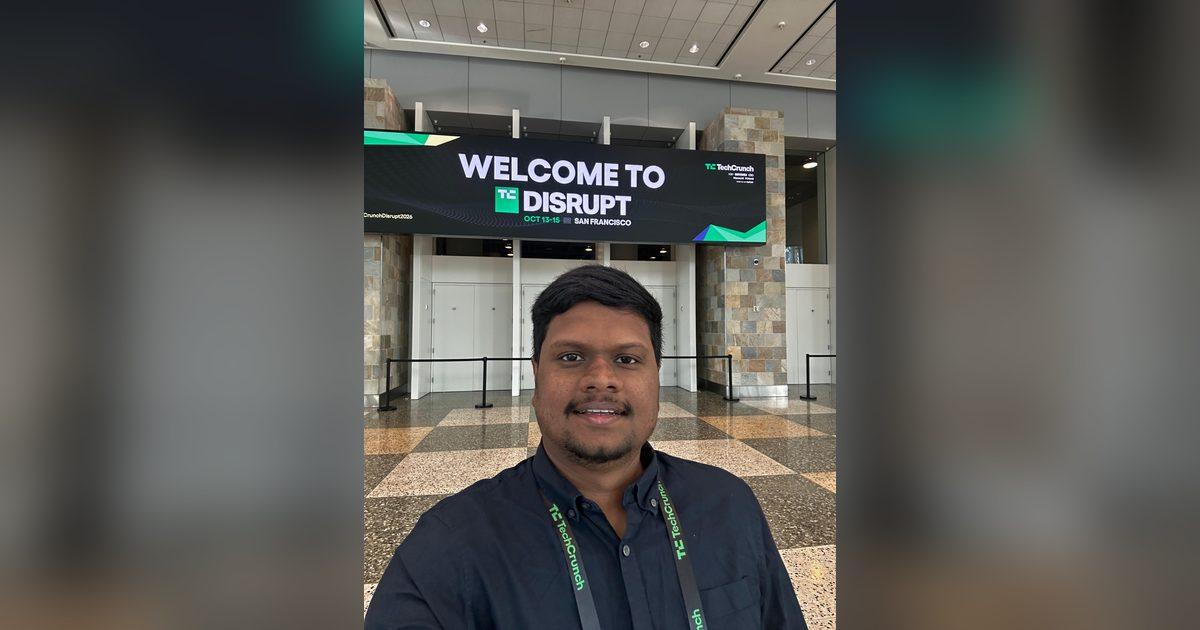
Intero Biosystems won Startup Battlefield at TechCrunch Disrupt 2026, with Apate as the runner-up, and they were exactly the two startups we had quietly backed to win. Watching them pitch taught me more about telling a startup's story than any talk on the subject. And on the last day of my three weeks in San Francisco, I saw my first real-life Hollywood actor.
How Startup Battlefield works
Startup Battlefield is TechCrunch's startup competition, and it is intense. Two hundred startups make the Battlefield 200, twenty of them pitch live on stage in San Francisco, and only five reach the final. This year's finalists were Apate, Flox Intelligence, Intero Biosystems, Industrial Next and Satlyt.
The winner takes home the Disrupt Cup and $100,000. Sitting in that hall during the final, you could feel what was riding on every minute.
Intero Biosystems: growing tiny human guts
Intero is a Denver startup founded by Charlie Childs and Madeline Eiken, with roots in the University of Michigan. It grows tiny human intestines: one-millimetre gut organoids, lab-grown tissue that behaves like the real thing, so drugmakers can test new medicines on human tissue instead of animals.
Think about what that means. Drug testing has leaned on animals for decades, and animals are not people. A test bed made of human tissue could tell researchers more, sooner, with fewer animals involved. And because the organoids produce biological data at scale, they are also a source of exactly the kind of data that AI models in biology are hungry for.
It is not their first win, either. The team had already taken the grand prize at the Rice Business Plan Competition.
Apate: AI that scams the scammers
Our other favourite, Apate, comes from Australia. It was founded by Dali Kaafar, a cybersecurity professor at Macquarie University, and it builds an army of AI agents that pose as convincing scam victims. They keep scammers busy on the line, waste their time, and gather intelligence about how the scams work. It has even been piloted with Australia's largest bank.
I love the idea. Most security tools build walls. Apate goes on the offensive and makes the scam business itself less profitable.
When the two of them ended up as winner and runner-up, it felt good. Like your football team winning, except one team grows human gut tissue and the other trolls criminals with AI.
A glimpse of where this is going
Intero's win stayed with me because of what it says about the future. Today it is a millimetre of human gut, grown for pharmaceutical testing and research. My mind immediately raced ahead. If we can grow working pieces of people now, where does that road end? Whole organs? Something even bigger?
I do not know. But it was a powerful reminder that the future is moving very, very fast, and that the most interesting startups are not always the ones in your own industry.
What their pitches taught me
The thing I will remember most is how they pitched. Two qualities stood out:
- Confidence. Not arrogance. The calm of founders who know their problem better than anyone in the room, and who have clearly answered every hard question before.
- Three clear horizons. What the company is now, what comes immediately next, and what the long-term vision is.
That second one is the magic. Take Intero as I understood it: now, gut organoids that pharmaceutical companies can test drugs on; next, the biological data those organoids generate at scale; and long term, a future where far more of medicine is tested on human tissue grown in a lab. Each horizon makes the others more believable.
When all three line up, a pitch stops sounding like an idea and starts sounding like a business with strong roots. It is a structure I want to steal for every pitch I give from now on. Try it on your own startup in three sentences: now, next, long term. If one of them is fuzzy, that is where your story needs work.
It is also a neat companion to YC's ten questions for evaluating a startup idea: one tells you whether an idea is worth pursuing, the other tells everyone else why it is. And it ties into the question that dominated the week: where your moat comes from when frontier labs can copy almost anything.
A Hollywood moment
The last day of Disrupt had some of the best sessions I attended all week. It also had Mark Wahlberg.
Yes, that Mark Wahlberg: the actor from the Transformers films, who also co-founded the clothing brand Municipal. The session was a conversation with Bruce K. Lee of Keebeck Wealth Management, and TechCrunch's write-ups cover the big themes: using AI in film the right way, and an affordable gym concept to take on the longevity crowd, with the first Municipal Gym opening outside Las Vegas in December.
I was very far back in the hall, so "met" is a strong word. But it was the first time I had ever seen a Hollywood actor in real life, and I am counting it.
Frequently asked questions
Who won Startup Battlefield at TechCrunch Disrupt 2026? Intero Biosystems won, taking the Disrupt Cup and $100,000. The runner-up was Apate, an Australian startup whose AI agents pose as scam victims.
Who were the Startup Battlefield 2026 finalists? The five finalists were Apate, Flox Intelligence, Intero Biosystems, Industrial Next and Satlyt.
What does Intero Biosystems do? It grows one-millimetre human gut organoids, tiny lab-grown intestines, so pharmaceutical companies can test drugs on human tissue instead of animals.
When and where was TechCrunch Disrupt 2026? TechCrunch Disrupt 2026 took place in San Francisco from 13 to 15 October 2026.
Did Mark Wahlberg speak at TechCrunch Disrupt 2026? Yes. The actor and Municipal co-founder spoke on stage with Bruce K. Lee of Keebeck Wealth Management, covering AI in film and a new affordable gym concept.
More from my San Francisco trip
- SF Tech Week 2026: are San Francisco founders superhuman?: the question I flew there to answer, and the city itself
- Moats, money and a US presence: what San Francisco's founders and investors taught me
- A Silicon Valley diary: Meta, Stanford, the HP garage, a Waymo that broke my trust, and my first poker night

Chief Technology Officer at Tellme AI · Founder of EchonLabs · Author of From Model to Product. Building AI systems that make it to production.
More about Dulan →Comments
Loading…
Get regular insights
A curated collection of thoughts, ideas, and innovations at the intersection of AI, technology, and engineering. No spam — only things worth your time.
By subscribing you consent to receiving email communications. Unsubscribe anytime. Privacy Policy