Moats, Money and a US Presence: What SF Founders Taught Me
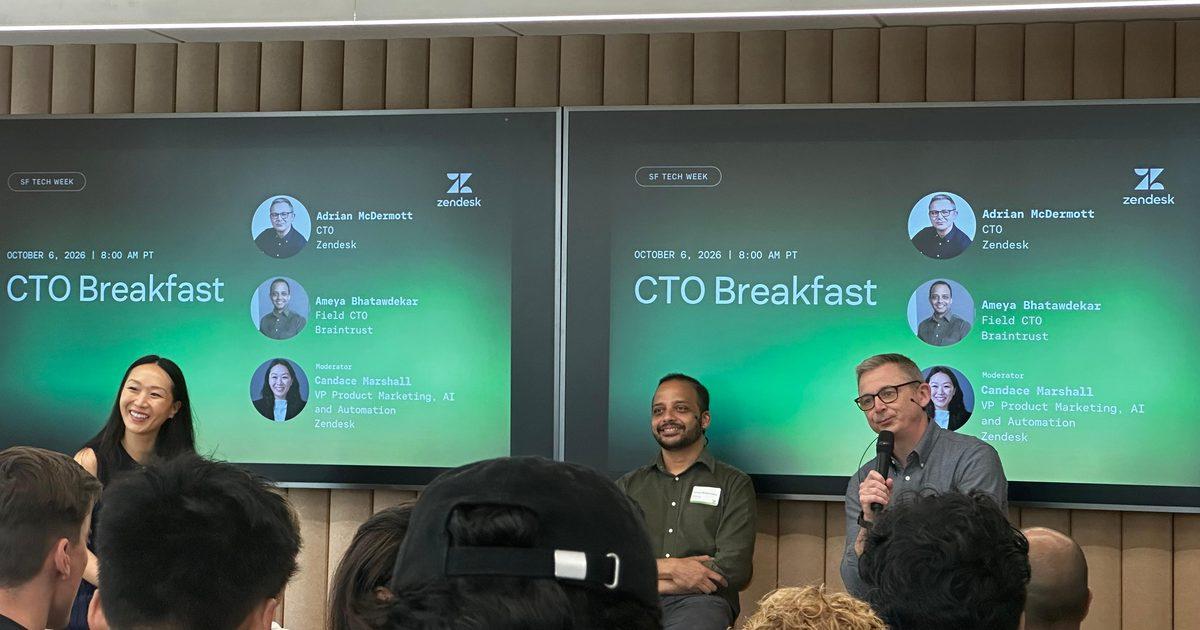
Three questions dominated almost every conversation I had at SF Tech Week 2026. How do you build a moat when a frontier AI lab can ship your startup as a feature? Where does early money really come from? And does a startup from outside the US need a US presence? The short answers I heard were: investors barely ask for a moat at pre-seed, investors were rarer than expected at events, and yes, you almost certainly need the US.
Here are the longer answers, plus what I made of them as a founder building from the UK. (For the people and the city, start with the first post in this series.)
The moat question
Every founder building with AI knows the feeling. You spend months on an idea, and then a frontier lab announces an update that does most of it, for free, for everyone. Startup ideas do not just get competed with any more. Sometimes they get deleted overnight.
So "where is the moat?" came up again and again, at talks, breakfasts and late-night conversations alike. The most surprising answer came from investors: at pre-seed, most of them are not really looking for a moat at all. They are looking at the team, the problem, and how fast you are learning.
But here is the part I liked. Almost everyone agreed it is still worth asking, constantly, where your moat might come from and how you could channel it as you grow. A moat is not something you have on day one. It is something you build towards.
My own view is that, for an AI startup, the moat rarely lives in the model. It lives in everything around it:
| What a frontier lab ships | What it rarely ships for your customer |
|---|---|
| A more capable general model | Your customer's data, cleaned and connected |
| A new feature for everyone | The exact workflow one industry runs every day |
| Benchmarks | Reliability in production, on the messy cases |
| Reach | The trust of customers who have watched you deliver |
That gap between a working model and a product people trust is exactly what I wrote about in From Model to Product, and it is why I wrote the book. The frontier labs keep making the model better. The last mile is still yours.
Zero to one to a thousand
The other big theme was go-to-market. How do you get from zero to your first customer, then to a hundred, then to a thousand? People shared the strategies they had actually followed, and it was fascinating to hold them up against the plans I had been sketching myself. Reassuringly, a lot of them lined up.
The way I now think about it is three different games:
- Zero to one is about the founders. You find the first customer yourself, by hand, and learn everything you can from them.
- One to a hundred is about finding a channel that works more than once, so growth stops depending on heroics.
- A hundred to a thousand is about systems: the product, the team and the process have to carry what the founders used to carry.
The biggest takeaway: what wins your first customer is rarely what wins your hundredth. Each stage needs its own playbook, and the danger is running the old one for too long.
The talk that stayed with me
Some sessions were high-level overviews. Nice, but forgettable. The one I keep coming back to was by Zach Yadegari, the young founder behind Cal AI, the app that estimates the calories in a meal from a photo.
What made it special was the depth. It was deeply technical, down to the minute details, with real examples of exactly what was done and how. No vague talk about "hustle". Just the specifics of how the thing was actually built and grown.
I love talks like that. Give me the specifics over the inspiration any day, because specifics are something you can actually use on Monday morning. It also made the story genuinely inspiring: when you see exactly how someone did it, it stops feeling like magic and starts feeling possible.
What everyone is building
If you want a snapshot of San Francisco's startup ideas right now, here is what I kept hearing, over and over:
- Evals, and platforms for running evals at scale.
- Regulation and compliance monitoring for AI systems.
- Platforms for AI agents: building, running and managing them.
It makes sense. As agents move into real products, everyone needs to know whether they work, whether they are allowed, and how to run them. Evals are now so central that "Evals Engineer" has become a job title in its own right, part of what I called software engineering's great re-bundling.
Which brings us straight back to the moat question. When half the room is building the same thing, what makes yours the one that survives? If you are weighing an idea in one of these spaces, run it through YC's ten questions for evaluating a startup idea first, or grab my free Startup Idea Scorecard.
Where the money actually is
You would expect SF Tech Week to be crawling with investors scouting for deals. It was not. Most events billed as "founders meet investors" were really founders meeting founders. Lovely for networking, less so if you came hoping to raise.
We did hear stories of founders who met an investor by chance, on the road, and walked away with a pre-seed cheque. It happens. It is not common, and when you dig in, there is always a reason the investor believed in that person.
The lesson I took: in San Francisco, events are for peers. Your peers are often how you reach investors, but the event itself is rarely where the money is.
Pre-seed without an idea
The more interesting stories were about people funded at pre-seed before they even had a startup idea. Why would anyone do that? Because those founders had spent years working at huge scale inside large enterprises, and investors put a real value on that knowledge. They were backing the person and the experience, not the pitch deck.
Tempting, right? But think it through. Money at that stage is priced on almost nothing but potential, so it can mean giving away a meaningful slice of your company before you know what the company is. If you later find the idea that really works, you will be building it with less of it.
There are pros and cons to everything here, and the lesson I took home was simple: decide when you want to raise, and why, rather than taking money just because it is offered. (If you prefer a riskier route, there is always raising startup funds at a poker table. Please do not.)
Do you need a US presence?
This was the question we asked most, because it is the one that matters most to us. Eamon and I build Tellme AI from the UK, and before that I spent years building EchonLabs from Sri Lanka.
We asked almost everyone we met, and the answers all pointed the same way: if you are serious about scaling, a US presence matters a lot. The reasons came down to four things:
- Some VCs can only invest in US companies. A number of funds have a restriction that they work only with US-registered companies, so without one, a whole slice of investors is simply closed to you.
- Better valuations. Several founders felt a US company raises on better terms than the same company registered elsewhere.
- Room to scale. If your customers are in the US, being there makes selling, hiring and growing far easier.
- The unicorn path. Nobody said you cannot become a unicorn from outside the US. But almost everyone said US roots make it a lot more likely.
"Presence" can mean several things: a US-registered company, people on the ground, US customers, or simply a lot of time in the city. None of this is legal or tax advice, and every company's case is different. But when every conversation points the same way, you notice. It is a big part of why I expect to be back in San Francisco often.
Frequently asked questions
Do pre-seed investors expect a startup to have a moat? Mostly not, from what we heard at SF Tech Week 2026. Pre-seed investors focus on the team, the problem and the speed of learning, while still expecting founders to think about where a moat could come from as they grow.
How can an AI startup compete with frontier labs? By competing where a general model cannot: closeness to a specific customer, their data and workflows, reliability in production, and the trust that comes from solving one problem very well.
What are the most common AI startup ideas in San Francisco right now? At SF Tech Week 2026 the recurring themes were evals and eval infrastructure, regulation and compliance monitoring for AI, and platforms for building and running AI agents.
Do non-US startups need a US company to raise from US investors? Not always, but some US funds can only invest in US-registered companies. Almost everyone we spoke to in San Francisco recommended having a US presence before raising seriously there.
Can you get pre-seed funding without a startup idea? Some people do, usually because of years of experience at scale in large companies that investors value highly. The trade-off is equity: money taken before there is an idea can cost a large share of the company early on.
More from my San Francisco trip
- SF Tech Week 2026: are San Francisco founders superhuman?: the question I flew there to answer, and the city itself
- TechCrunch Disrupt 2026: lessons from Startup Battlefield: gut organoids, scam-baiting AI and a Hollywood moment
- A Silicon Valley diary: Meta, Stanford, the HP garage, a Waymo that broke my trust, and my first poker night
Chief Technology Officer at Tellme AI · Founder of EchonLabs · Author of From Model to Product. Building AI systems that make it to production.
More about Dulan →Comments
Loading…
Get regular insights
A curated collection of thoughts, ideas, and innovations at the intersection of AI, technology, and engineering. No spam — only things worth your time.
By subscribing you consent to receiving email communications. Unsubscribe anytime. Privacy Policy